ENOS.
A new novel · forthcoming

The conquest of the West · 1846–1851

Enos

Witness to the American West.

He spoke Spanish when paid, French when it saved trouble, English when cornered. He carried other men's messages across a continent that was being taken while he watched. History called him a renegade and hanged him. This novel hands him back the one thing the record never gave him — the telling.

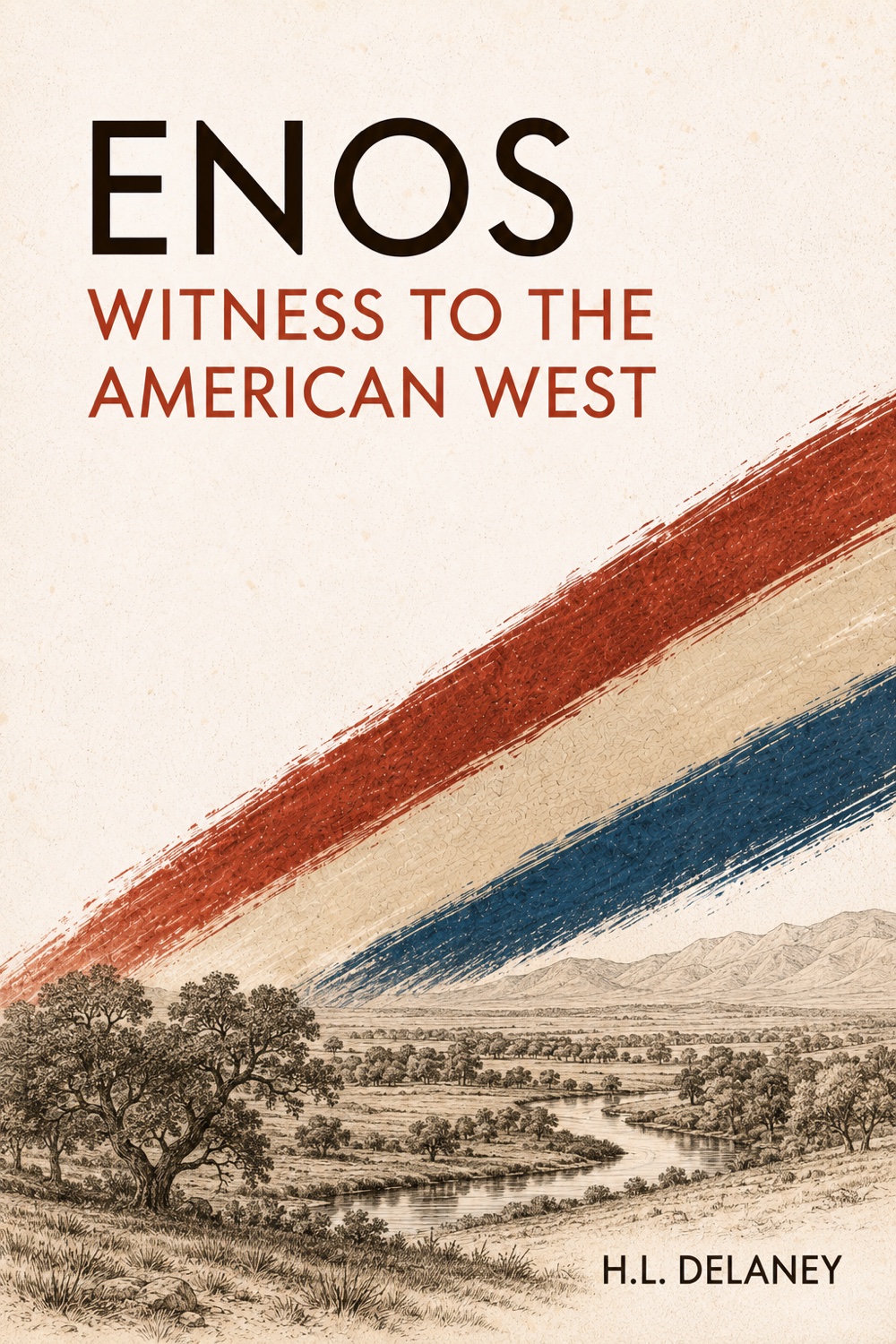
Cover of Enos: Witness to the American West by H.L. Delaney — a California river valley under a red, buff, and blue brushstroke.

A man the record could only spell wrong.

Enos belonged to the part of the West that does not survive in clean print — the guides, interpreters, packers, and hired men who moved between armies and nations and were written down, when they were written down at all, under whatever name a clerk could manage that morning. Eneas. Enos. Enez. He answered to several and trusted none of them.

What the documents agree on is small and damning: he was a horseman and an interpreter; he crossed the country in the company of powerful men during the years the United States took the Far West by force; and he ended on a gallows on the Oregon coast, convicted by people who needed the story to have a villain in it. Everything between is where a novel lives.


1846

In Frémont's shadow

The year John C. Frémont's expedition turned the Far West into a battlefield. Enos was the kind of man such expeditions ran on and forgot.

Polyglot

Four tongues, no country

Spanish, French, English, and trade Chinook. The men who trusted him were the ones who didn't count their horses afterward.

The ledger

Conquest as paperwork

The West changed hands in account books and clean dispatches. The novel reads the conquest the way Enos did — as bookkeeping.

1851

Battle Rock

The Oregon coast, a siege, a massacre, and a hanging. The record closes the case. The novel reopens it.

The year the continent changed owners

In the spring of 1846 John C. Frémont led an armed "exploring" expedition through Mexican California and up toward the Oregon country, with Kit Carson among his men. A Marine lieutenant named Archibald Gillespie chased them north with secret dispatches from Washington and caught Frémont near Klamath Lake. What was said in that camp has never been fully accounted for. What followed is documented: after Klamath people attacked the expedition in the night, Carson and Frémont's men struck back, burning a Klamath village and killing without much regard for who had done what.

Frémont turned south, and within weeks American settlers raised the Bear Flag and the conquest of California was on. Two thousand miles east, in the Senate, Frémont's father-in-law Thomas Hart Benton was giving the conquest its language — a destiny written into the blood of a "superior" race. The men with rifles and the men with speeches were working the same seam.

Every country began with men saying they had found an empty place and ended with a clerk too tired to spell the dead correctly. from Enos: Witness to the American West

Enos was somewhere in the middle of it — not deciding anything, just close enough to see how the deciding was done. That vantage is the whole novel: the conquest of the West from the eye level of a man it used and discarded.

They court-martialed the conquest

When the fighting in California was over, the victors fell out among themselves. Frémont, caught between General Kearny and Commodore Stockton over who truly governed the conquered territory, was arrested and court-martialed in Washington in 1847. The charge was mutiny. The proceeding was really about authorship — who got to write the official version of how the West was won, and whose name went on it.

That is the quiet engine under this book. The conquest was not only fought; it was filed. Speeches became policy, raids became reports, and the dead became a column too long to spell correctly. Enos watched men turn what they had done into what could be printed, and he understood, the way only a hired witness can, the distance between the two.

The gallows on the coast

The witness's road ended on the Oregon coast. In 1851, at a sea-stack the Americans called Battle Rock near Port Orford, and in the killings that followed up the Coquille, the violence of the conquest came down to particular bodies and particular names. Enos was made one of those names. The people who needed the story to close convicted him and, a few years later, hanged him on that same coast.

The novel does not give him a confession or a vindication. It gives him a last look — the French he kept for trouble, narrowed to two words: Je te vois. I see you. It is the one verdict the record could never enter, and the only one the witness had left to deliver.

Cover of Enos: Witness to the American West by H.L. Delaney.

Enos

Witness to the American West — a novel by H.L. Delaney

A dry-eyed, deeply voiced Western about the year the United States took the Far West, told from the saddle of a man who was paid to be present and trusted to be silent. Frémont and Carson move through it; so do Benton and Jessie and the clerks who turned a conquest into a clean sentence. Enos works the horses, reads the room, and keeps the account no one asked him to keep.

It is a novel about how history gets written, and about the witnesses it can't afford to believe.

Forthcoming from Basalt Sea Press · a Native-owned house.

H.L. Delaney

H.L. Delaney is a novelist and an enrolled member of the Klamath Tribes, with Modoc ancestry. His work returns to the same hard ground: Native lives caught in the machinery of American expansion, told without romance and without flinching. Enos is his novel of the conquest of the West.

More at hldelaney.com.

Go deeper

Short, sourced pieces on the real history beneath the novel — Frémont at Klamath Lake, the Gillespie dispatch, Benton's destiny of race, the Frémont court-martial, and the Battle Rock killings.

Enter the Reading Room →